
Insurers don’t just rate “a car”, they rate the cost and likelihood of a claim on that specific vehicle. Two cars that look similar on the driveway can sit in very different risk categories once repair costs, theft rates and parts availability are factored in.
This guide explains how different vehicle types are commonly assessed in UK car insurance underwriting. It’s written to help you predict the likely pressure points before you start comparing quotes, particularly if you’re changing cars or moving into a less typical category.
Everyday Hatchbacks and Family Cars
Mainstream cars with strong parts availability and established repair networks are often simpler to insure. That doesn’t mean they are always cheap, because postcode and driver profile still matter, but insurers tend to have plenty of data and predictable repair pathways for common models.
Insurance group, safety features and theft attractiveness still play their part. A popular model can be both easy to repair and popular with thieves. It cuts both ways.
Small City Cars
Small engine city cars are often associated with lower premiums because repair bills can be lower and performance is modest. But they are also commonly driven in urban areas with higher accident frequency, and some are frequently used by new drivers, which can push pricing up.
If you are choosing a first car, don’t rely on size alone. The insurance group and theft profile usually tell you more than the badge.
Performance Cars and Hot Hatches
Performance models are often priced higher because claim severity tends to be higher, repairs can be more expensive, and certain models attract theft or vandalism. Insurers also consider how the vehicle is typically used, including higher annual mileage, motorway driving and higher-speed risk patterns.
Even within the same model family, a higher trim level can move you into a different insurance group. The difference can be bigger than people expect.
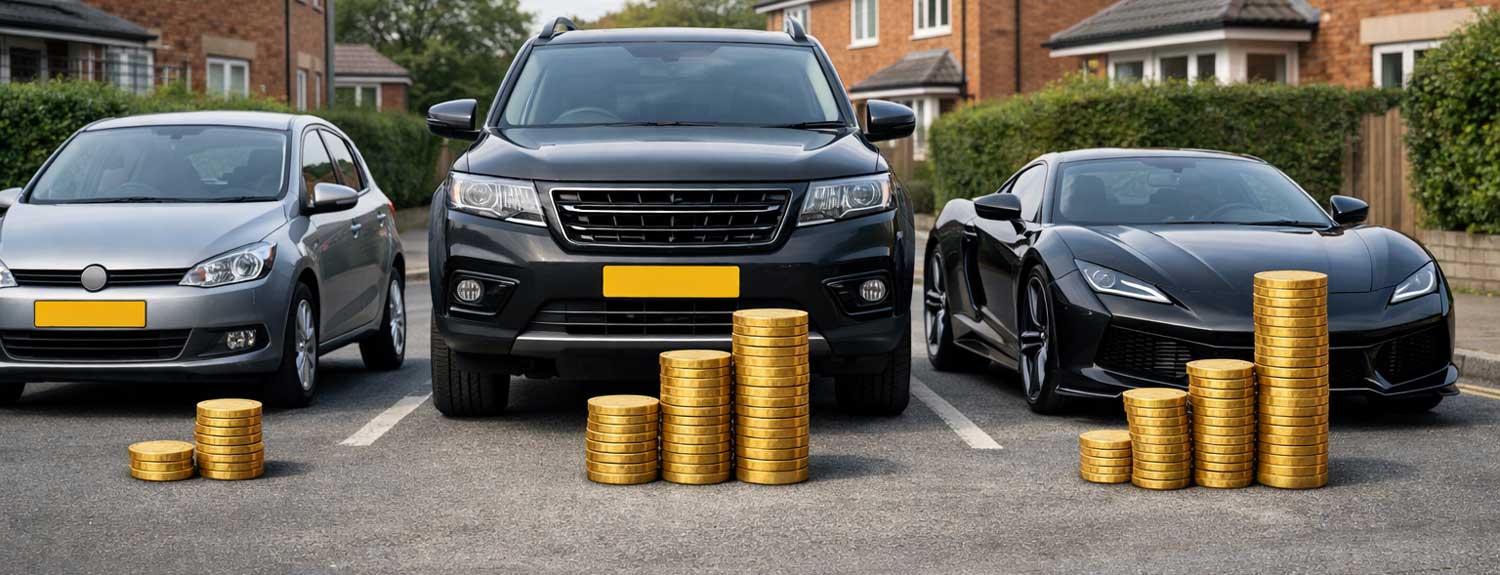
All other factors being the same, the larger and faster the car, the higher the premium might be.
Electric Cars
Electric car premiums can vary widely. Some EVs are competitively priced, others are not. Battery-related costs, specialist repair requirements and parts availability can influence claims costs. Even minor collisions can be expensive if sensors, high-voltage components or battery housings are involved.
Insurers may also consider where the car is kept and whether it is likely to be charged at home, on-street or in public locations, mainly because that links to theft exposure and usage patterns rather than the charging itself.
Hybrids
Hybrids sit somewhere between mainstream petrol or diesel cars and full EVs. In many cases they are treated as ordinary passenger vehicles, but repair complexity can be higher depending on the model. Some hybrids have excellent reliability and repair networks, others require more specialist work.
The difference is often in parts pricing and repair time, not the technology label.
Modified Cars
Modifications can affect both acceptance and price, mainly because they change the risk profile and the cost to repair or replace. Insurers usually separate modifications into categories such as:
- Performance changes (engine, remapping, exhaust)
- Handling and braking changes (suspension, brakes, wheels)
- Cosmetic changes (body kits, wraps, paint)
- Security upgrades (approved alarms and trackers)
Some modifications increase risk. Others increase replacement value. Either way, the insurer needs accurate disclosure. If a modified vehicle is insured as standard and a claim occurs, the policy response may be affected.
Imports and Grey Imports
Imported vehicles can reduce the number of insurers willing to quote, especially where parts availability is limited or where the model is unfamiliar in the UK market. Insurers often focus on:
- Whether the vehicle is UK registered and has a UK V5C
- Parts availability and repair network
- Security specification compared with UK models
- Replacement value and sourcing time
Some imported models are straightforward, others are treated as specialist risks. It depends on how common they are and how easy they are to repair.
Classic Cars
Classic car insurance is often arranged on a different basis from standard motor cover. Insurers may ask about limited mileage, storage arrangements and whether the vehicle is used daily or only for events and fair-weather driving.
Valuation is also handled differently. Some classic policies use agreed value, where the insurer accepts a valuation upfront, rather than relying purely on market value at claim time.
Cars on Finance and High Replacement Value Vehicles
Cars on finance are insured like any other, but the financial arrangement can matter after a total loss. The insurer pays out based on the policy valuation basis, and outstanding finance is then settled according to the finance agreement terms.
Higher value vehicles often cost more to insure because claim severity rises quickly. Even when theft risk is controlled, repair bills can be substantial due to advanced driver assistance systems and higher parts pricing.
Written-Off and Previously Repaired Cars
Cars that have been written off in the past can still be insured, but acceptance varies. Insurers may treat them differently depending on the write-off category and whether the car returned to the road with the correct documentation.
If this applies to you, see Car Insurance for Written-Off Cars.
How to Think About Vehicle-Related Pricing
When you change car, the biggest pricing drivers are usually:
- Insurance group and performance level
- Theft attractiveness of the model
- Repair complexity and parts availability
- Replacement value and lead time for repairs
- How and where the car is kept
Driver profile and location still matter, but vehicle choice sets the baseline. If you are comparing models, it can be worth checking insurance quotes before buying, especially for EVs, performance trims and imported variants.
For the wider picture of how insurers calculate pricing, see What Affects Car Insurance Costs?. For renewals, changes and mid-term adjustments, Managing Your Car Insurance Policy explains how policies are typically managed.
 They are members of the British Insurance Brokers Association, John Stow House, 18 Bevis Marks, London EC3A 7JB; Membership number: 007759.