
No claims bonus, often shortened to NCB, is one of the main reasons two drivers with similar cars can pay very different premiums. It’s also one of the areas that causes the most confusion, partly because insurers don’t all handle it in exactly the same way.
This page explains how no claims bonus typically works in UK car insurance, how it links to your wider driving and insurance history, and what insurers commonly ask for when you switch or renew.
What No Claims Bonus Actually Is
No claims bonus is a discount earned for each claim-free year on a motor policy. In most cases, it builds year by year. The key point is that it is linked to your insurance record, not your driving skill in the abstract. It’s based on whether a claim was made on a policy in your name during that period.
NCB is usually shown as a number of years. Some insurers cap the maximum number of years they recognise for discount purposes, even if you have more.
How Claims Affect NCB
Claims tend to affect pricing in two different ways. First, they can reduce or remove your no claims bonus. Second, they can influence how an insurer rates your risk at renewal, even if NCB is protected.
Not every claim affects NCB in the same way. For example, some non-fault claims may still influence pricing even when your bonus remains intact. It depends on the insurer’s approach and the type of incident recorded.
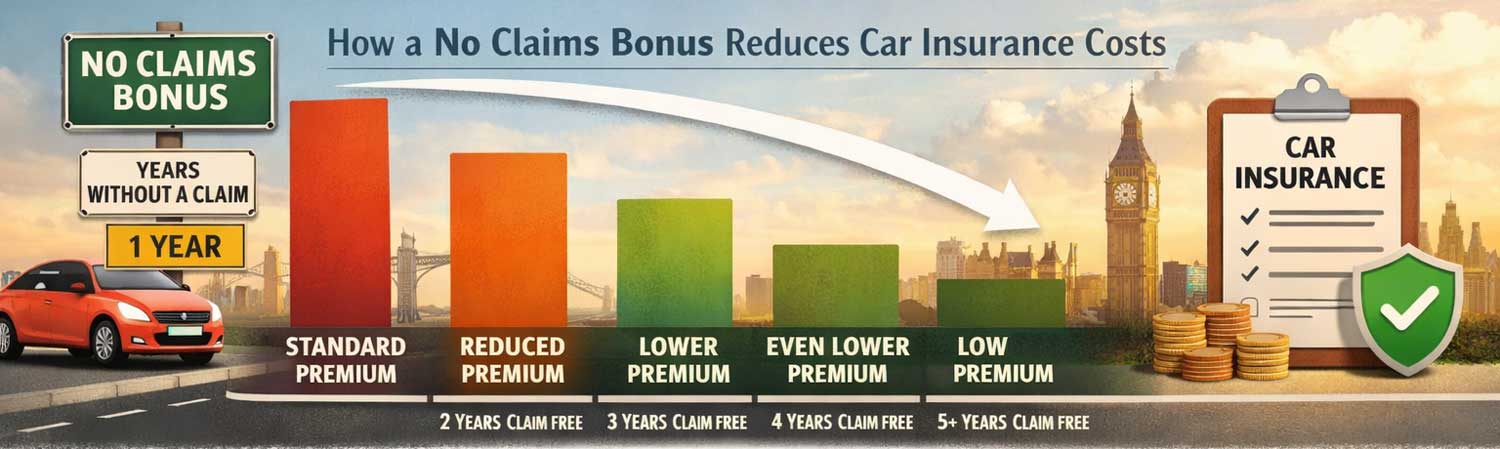
Often, the longer the no-claims bonus, the lower the premium.
Protected No Claims Bonus
Protected NCB usually means you can make a limited number of claims within a set period without losing all of your discount. The exact allowance and time window varies between insurers, so it is worth checking what your policy terms say.
Protection helps preserve the discount level. It does not automatically prevent a premium increase after a claim, because claims history still affects risk rating.
Proving Your NCB
When you move to a new insurer, you are often asked to prove your NCB. Proof is usually provided as:
- A renewal notice showing NCB years
- A letter or email from your insurer confirming NCB
- Policy documentation showing the earned years at the end of the term
Insurers often request proof within a set timeframe after the policy starts. If proof is not provided, the premium may be adjusted or the policy may be at risk of cancellation, depending on insurer rules.
Transferring NCB to a New Policy
NCB is normally transferred from one policy to another when you change insurer or change vehicle. The receiving insurer may recognise your full number of years, or they may cap it for discount purposes. That cap does not mean your history disappears. It just means the discount calculation stops increasing after a certain point.
If you are changing cars mid-policy, NCB usually continues as normal. If you cancel the policy part way through the year, the completed year may not count as an additional year of bonus.
Using the Same NCB on Two Cars
In most cases, you cannot use the same NCB on two separate policies at the same time. If you insure two cars, you would normally build NCB on one primary policy and start from zero or a lower level on the second, unless the insurer offers a specific arrangement such as mirrored or introductory discounts.
Multi-car policies sometimes include discounts that feel similar to NCB, but they are usually separate from your core earned bonus. It helps to treat them as different things.
What Counts as a “Gap” and Why It Matters
Insurers often ask whether you have had continuous insurance. A short gap may not matter. A longer gap can reduce the number of insurers willing to quote or can affect pricing, especially if it appears you owned a vehicle while uninsured.
Some insurers allow you to reuse NCB after a period without a policy, but the acceptable gap varies. If you have been off the road for a while, it is worth checking how many years of NCB will still be recognised.
Driving History Beyond NCB
NCB is not the whole story. Insurers also use wider driving and insurance history, including:
- Claims (fault and non-fault) and incident dates
- Convictions and points
- Previous cancellations or voided policies
- Insurance gaps and previous insurer changes
These details can influence pricing even if your NCB remains strong. It is possible to have many years of NCB and still see higher premiums after a claim, a conviction or a change in circumstances.
Keeping Your History Consistent Across Quotes
When you compare quotes, consistency matters. Differences in how you answer questions about claims dates, fault status or convictions can change the outcome. It is worth keeping a record of key dates so you don’t end up accidentally giving different versions of the same history across applications.
For the bigger picture of how your history interacts with pricing, see What Affects Car Insurance Costs?. If you are dealing with renewals, changes or cancellations, Managing Your Car Insurance Policy explains how those processes typically work.
 They are members of the British Insurance Brokers Association, John Stow House, 18 Bevis Marks, London EC3A 7JB; Membership number: 007759.